- 9 Posts
- 30 Comments


 161·3 months ago
Well, OK, but was her soul within its system?
—AI apologist, probably
yeah, it does… Pretty unrelated, though. or IS IT.

 3·7 months ago
lol, there is a place on this table for pedestrian-pedestrian crashes.
I just looked at the git history 2 days later and there are around 7 committers now. It may yet fail, but it is not just one person any more. Also, though, like liberally why lol. vim is such garbage. helix and kakoune are way better.

Showed up here a month later. The link is dead. Can anybody find this again? I already looked on the web archive. It’s not there.


So wait, are you disparaging humans, praising humans, disparaging birds, or praising birds?
 4·11 months ago
I used to think it didn’t matter how electricity is used to generate heat, so I came to the same conclusion you did. Surprisingly, it does matter. Rather than a computer’s resistive heating, it is much more efficient to refrigerate the outdoors and point the refrigerator’s heat sink indoors. This is how a heat pump works. It’s basically awesome.
Laptops are better, because they have an integrated uninterruptible power supply, but worse because most can’t fit two hard drives internally. Less of a problem, now that most have USB3. Just run external RAID if you have to.
Arguably, a serious home server will need a UPS anyway to keep the modem and router online, but a UPS for just the NAS is still better than no UPS at all. Also, only a small UPS is needed for the modem and router. A full desktop UPS is much larger.
Wikipedia doesn’t say anything about efforts to detect AI-generated content or to ensure only humans can edit. This is bad. I’m saving a copy of 2024 Wikipedia just in case.
Interestingly, Wikipedia actually is testing AI technology, but not for editing or for content creation or even for searching. It wants to use it to assist in vandalism detection. Not a bad idea TBH, but I could definitely see how this could go wrong lol.

Grok:
Should I invest money in AI? Yes or no.
Yes, but with caution and diversification
Investing in AI can be a smart move given its explosive growth trajectory and transformative potential, but it’s not a blanket “yes” for everyone—especially if you’re risk-averse or new to the market. AI is projected to drive massive economic value, with global spending hitting nearly $1.5 trillion in 2025 alone, fueled by infrastructure like data centers and chips. Private investment reached a record $109.1 billion in the U.S. in 2024, outpacing rivals like China by 12x, and generative AI alone pulled in $33.9 billion. This isn’t hype; it’s backed by real adoption—88% of executives plan to boost AI budgets in the next year, with high performers seeing EBIT lifts of 5%+ through workflow redesigns and scaling. By 2026, AI could accelerate U.S. GDP growth to 2.25%, stabilizing labor markets and unlocking productivity gains across sectors like manufacturing and logistics.
That said, the risks are real and mounting. AI stocks have soared on exuberance, but valuations are stretched—some trade at 50x revenue multiples, raising bubble fears akin to the dot-com era. Recent pullbacks in names like Nvidia highlight volatility, with concerns over whether massive capex (e.g., hyperscalers’ $300B+ spend in 2025) will yield quick profits. Job displacement could hit 100 million roles in the next decade, sparking recessions or social backlash, while concentration in mega-caps like NVDA adds systemic fragility. Geopolitical tensions (U.S.-China chip wars) and ethical issues like data privacy could trigger regulations that slow momentum.
Quick Pros vs. Cons Breakdown
Aspect Pros Cons Growth Potential $200B global AI investment by 2025; 18.7% YoY rise in gen AI funding. Returns lag: Most firms see <5% revenue boost so far; capex may not pay off soon. Market Momentum Deal values up 127% YoY; AI-native firms hitting strong ARR. Bubble risks: 45% of fund managers flag AI as top market threat; sharp selloffs ongoing. Long-Term Impact Reshapes industries (e.g., humanoid robots, agents); triples revenue/employee in exposed sectors. Volatility & ethics: High beta stocks; job losses, privacy regs could backfire. How to Invest Wisely (If You Do)
- Diversify: Skip single stocks like NVDA (too concentrated—it’s 62% of some revenues). Opt for ETFs like BOTZ (robotics/AI) or IRBO (global AI) for broad exposure, reducing company-specific risks.
- Focus on Fundamentals: Target “AI adopters” (e.g., diversified tech like MSFT, GOOGL) over pure creators for stability. Look for firms with clear ARR paths and ethical governance.
- Risk Management: Allocate no more than 5-10% of your portfolio; hedge with gold or broad indexes (e.g., S&P 500) against bubbles. Rebalance quarterly.
- Timeline: This is a 5-10 year play—AI’s full GDP impact may not hit until 2030.
Ultimately, if your risk tolerance aligns with tech’s ups and downs (think 20-30% swings), yes—AI could be as disruptive as the internet. But consult a financial advisor, DYOR, and never invest what you can’t lose. Recent X chatter echoes this: Excitement around NVDA and TSLA fleets, but warnings on bubbles. What’s your timeline and risk level? That’ll tip the scales.
Notably no mention of conflict of interest with Grok!
The 401, specifically, is a big reason I moved to Europe. This is the first time in half a year I heard the words “four oh one”, and it’s been the least stressful six months of my life.
I’ll have to check out bspwm.
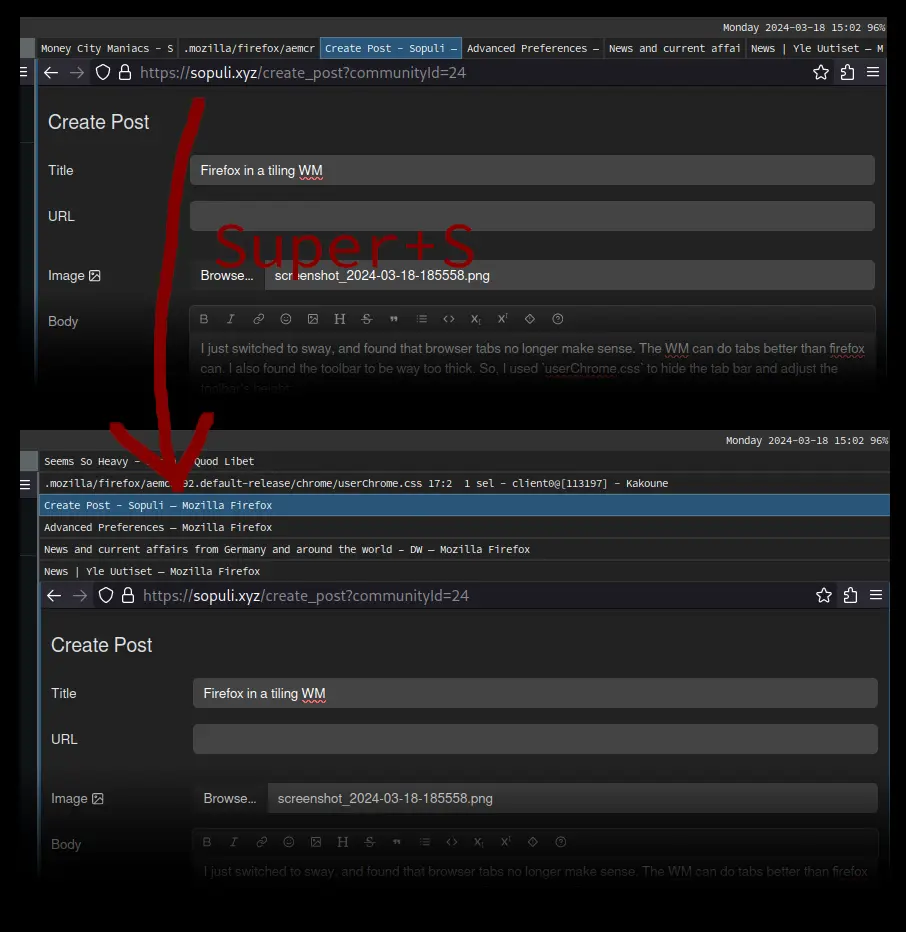
And the chrome.css method is the same as I use. Darn, I was hoping for an easier way.

Woah. How did you hide the tab bar etc. in librewolf? Because it was a real pain in firefox lol.
Also, what wm do you use?
Nintendo makes it as hard as possible to use their computers generically.
Nintendo fanboys: “Thankyou, sir, may I have another?”
You only saw the tabs open on this workspace.
But yeah I don’t have hundreds of tabs open. It is incompatible with my workflow. Only the “tabs” directly relevant to whatever is currently happening in the current workspace are kept open.
A link either gets read or it doesn’t. If I don’t have time to read a link somebody sends me personally, I just tell them that. I don’t string anybody along about a link I know I will never read. I can’t allow for any link backlog. That leads to . . . dark places.
Also, I don’t really use bookmarks either. When I disable search suggestions and use firefox suggest, it leave more space for history. It works so well I don’t really need to bookmark anything. Frequently opened sites make their way to the top on their own.
Fucking do it.
You will find no argument here about the problems that arise when corporations are not required to pay for the garbage they produce.
However.
Optimising incandescent lightbulb efficiency is actually not easy to do. It is easy to make a lightbulb that lasts literally forever, if you run it cooler. But if you do that, your power efficiency will be total shit. (And your light will be uncomfortably red, but let’s say that’s less important for now.) You will waste a lot of money on your electricity bill. There will come a point when you will be wasting more money on electricity than the lightbulb is worth. This breakeven point is difficult to determine. It is a calculation that the average consumer shouldn’t be burdened with.
Large parts of the City of Toronto bike share—public infrastructure—requires such an app. Taxpayers without an iphone or android computer can’t access the services they already paid for.
Mostly a bad thing. Even Avtar thinks he shouldn’t have been able to find his mother using AI. Not to mention, many people don’t want to, and shouldn’t, be found.